Meridian Field Services.
How a multi-region field-services enterprise replaced five fragmented systems with a single AI-powered operations platform — and turned operational data into executive decisions.
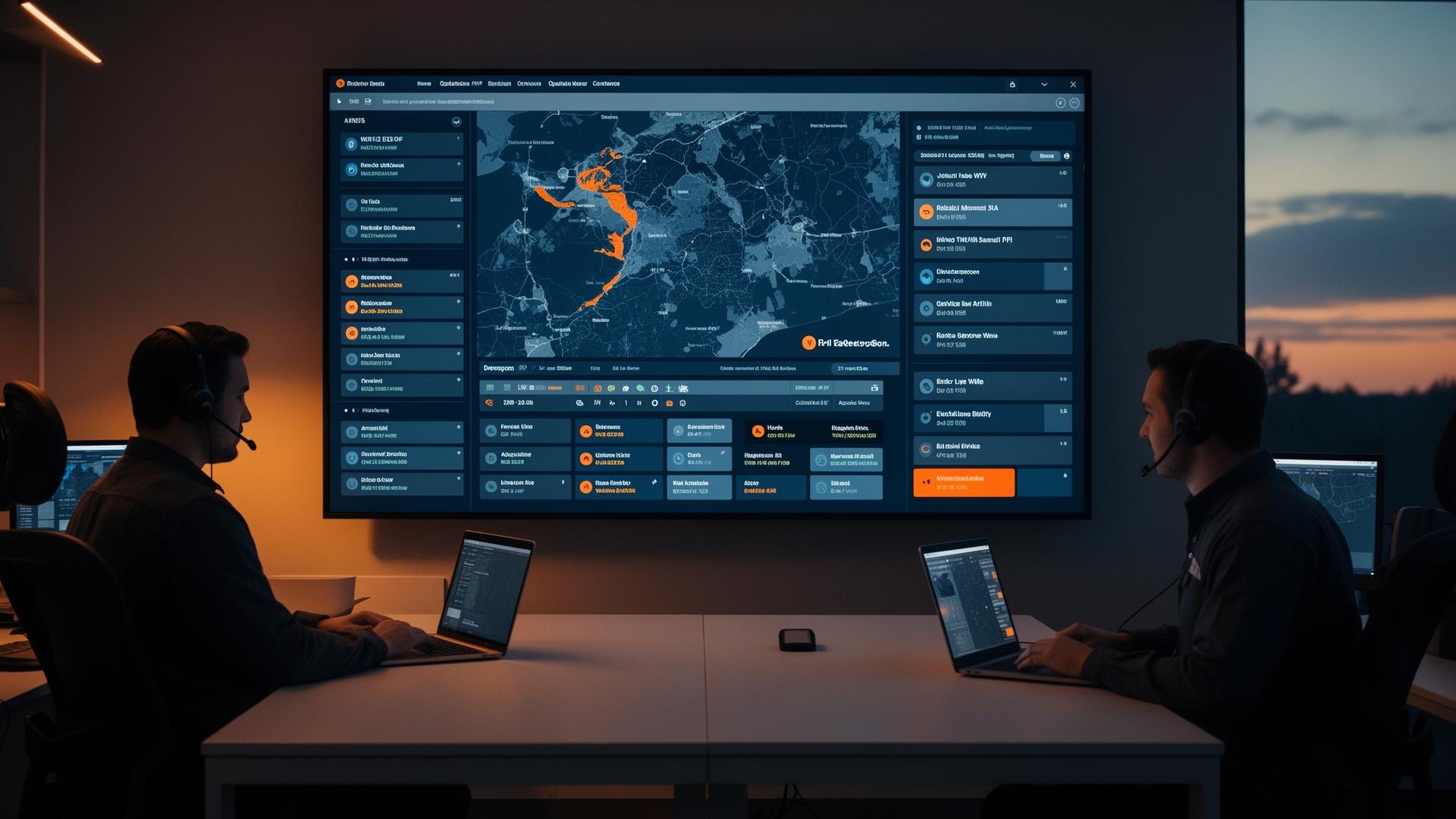
Project overview
One platform.
Every workflow.
Meridian's leadership had a clear thesis: the next decade of growth depended on operational excellence, not headcount. We delivered the platform that made that thesis real.
- Industry
- Field Services · Facilities Management
- Business type
- Multi-region enterprise (B2B & B2B2C)
- Project duration
- 11 months · 4 phased releases
- Team size
- 14 — product, engineering, AI, design, QA
- Technology ecosystem
- React · TanStack Start · Node · PostgreSQL · Azure
- AI capabilities
- Classification · Recommendation · Forecasting · RAG assistant
- Key integrations
- ERP · CRM · Telephony · SMS · Payments · Mapping · SSO
01 / Business challenge
Growth was being capped by the operating model.
Disconnected operations
Customer records, service requests and field activity lived in five disconnected systems. Every cross-team workflow required manual reconciliation.
No real-time visibility
Operations leaders had no single view of jobs in flight, technician load or SLA risk — reporting was a Monday-morning spreadsheet exercise.
Slow response times
Median request acknowledgement sat above 90 minutes; dispatch decisions were made by tribal knowledge, not data.
Resource allocation drift
Skilled technicians were under- or over-utilised by region; high-margin work was being assigned by availability alone.
Customer experience gap
Customers had no self-service status, no ETA visibility, no consolidated communication thread.
Scaling ceiling
Onboarding a new region took 6–8 weeks of manual configuration. Growth plans were being capped by the operating model, not the market.
02 / Discovery & strategic planning
Twelve weeks of rigour before a single line of product code.
Executive workshops
Two structured working sessions with the C-suite to align on transformation outcomes, investment thesis and the non-negotiables.
Process mapping
End-to-end mapping of 23 operational workflows across intake, dispatch, execution, billing and post-service — captured as living artifacts the client now owns.
Operational audit
Quantified the cost of fragmentation: 4,200 hours/year of manual reconciliation across operations and finance.
User journey analysis
Shadowed dispatchers, technicians and account managers in three regions — turned observations into a prioritised friction inventory.
Technology assessment
Reviewed the existing stack against scalability, integration, security and total-cost-of-ownership criteria. Recommended a phased re-platform rather than a forklift replacement.
Scalability planning
Designed the target architecture and AI roadmap around a 3-year growth model — 4× job volume and 2× regions without re-architecture.
03 / Solution delivered
A unified operations platform — six modules, one source of truth.
Customer management
A single, governed customer record with full interaction history — calls, emails, jobs, invoices, sentiment — surfaced contextually to every team.
Service operations
End-to-end orchestration of intake, triage, scheduling, dispatch, execution and closure with SLA timers, escalation rules and audit trails baked in.
Workforce management
Resource planning, skills matrix, live assignment tracking, performance scorecards and a purpose-built mobile experience for the field.
Reporting & analytics
Real-time operational dashboards for dispatch, region-level scorecards for ops leaders and executive intelligence views for the C-suite.
Mobile accessibility
Offline-capable mobile experience — technicians accept, navigate, document and close jobs in the field; photo, signature and parts capture in-flow.
Integration framework
A documented integration layer connecting ERP, CRM, telephony, SMS, payments, mapping and SSO — extensible by the client's internal team.
04 / AI transformation layer
AI as a practical business enabler — not a feature on a slide.
Every AI capability was scoped to a measurable operational outcome, evaluated against a golden dataset before release, and shipped with human-in-the-loop guardrails.
Intelligent request classification
Incoming requests — across web, phone and email — are automatically classified by urgency, complexity and required expertise. Routing latency dropped from hours to seconds.
Smart assignment recommendations
The dispatcher sees a ranked list of best-fit technicians using skills, availability, current workload, location and historical performance — with the rationale shown inline.
Predictive insights
Workload forecasting, churn risk and SLA-breach prediction surface on the operations dashboard, giving leaders 24–72 hours of forward visibility.
AI knowledge assistant
A retrieval-grounded assistant gives technicians and support agents instant access to procedures, SOPs, troubleshooting trees and warranty terms — sources cited, never hallucinated.
Executive intelligence
Operational data is translated into a weekly executive narrative — what changed, why, what to act on — replacing a deck-building exercise that used to consume two analyst days a week.
05 / Implementation journey
Nine phases. Four shippable releases. Zero forklift cutovers.
01
Discovery
Stakeholder alignment, current-state audit, outcome definition.
02
Strategy
Investment case, phasing plan, success metrics, governance model.
03
Solution architecture
Target architecture, data model, integration topology, AI roadmap.
04
Experience design
Dispatcher console, technician mobile, customer portal, executive views.
05
Development
Four phased releases — each one shippable, each one measured.
06
AI enablement
Model selection, eval harness, RAG pipeline, human-in-the-loop guardrails.
07
Quality assurance
Automated regression, performance budgets, security review, UAT with real operators.
08
Deployment
Region-by-region rollout with parallel running and structured cutover.
09
Optimisation
Quarterly review cadence, AI model retraining, roadmap re-planning with the client.
06 / Key business outcomes
The numbers the board cared about.
Faster median response time
Lift in technician productivity
Reduction in manual reconciliation hours
Improvement in first-time-fix rate
Customer satisfaction (CSAT) lift
New region onboarding (weeks → days)
Combined effect: full ROI inside year one, with the platform now operating as Meridian's most leveraged growth asset.
07 / Technology ecosystem
Chosen for scale, security and what comes next.
Frontend
- React 19
- TanStack Start
- TanStack Query
- Tailwind
- Framer Motion
Mobile
- React Native
- Offline-first sync
- Background geolocation
Backend
- Node.js
- TypeScript
- Hono
- Event-driven workers
Data
- PostgreSQL
- Read replicas
- Materialised views
- Object storage
AI
- Azure OpenAI
- Embeddings + pgvector
- RAG pipeline
- Evaluation harness
Integration
- REST
- Webhooks
- Message queue
- SSO (SAML/OIDC)
Cloud
- Azure
- Container apps
- Managed Postgres
- CDN + WAF
Client feedback
"We didn't buy a piece of software — we changed how the business runs. Response times are down, our technicians are happier, our customers actually see what we're doing for them, and the executive team finally has the operating picture we'd been asking for for years. The AI work landed quietly, which is exactly what good AI should do."
— Chief Operating Officer
Meridian Field Services
08 / Long-term impact
From operational system to intelligent business platform.
What started as a re-platforming engagement is now Meridian's strategic operating layer. New regions go live in days. New service lines plug into the same workflows. AI capabilities ship behind feature flags with measurable impact on the operations dashboard.
The roadmap ahead — autonomous dispatch suggestions, customer self-scheduling, predictive maintenance for installed assets — extends from the platform we built, not around it. The transformation continues, but the foundation is done.